
.png)
Key Takeaways
- CPA pays for a defined action, CPL pays for a qualifying lead, and CPS pays for an eligible sale. Campaign requirements determine when a conversion earns a commission.
- The right model depends on your audience’s intent, your traffic source, and the level of commitment required to complete the conversion.
- Compare approved earnings, acquisition costs, validation timelines, and payment terms before increasing traffic. A higher payout does not automatically mean a better opportunity.
Two affiliate offers can target the same audience and produce very different results. One may pay for a qualifying inquiry, while another requires a completed purchase or a verified account with an additional transaction.
Choosing between CPA, CPL, and CPS starts with understanding what your visitors are ready to do and what the advertiser considers a payable result.
This guide explains how the models differ, which types of traffic may suit each one, and how to compare their performance before committing more time or advertising spend.
What Do CPA, CPL, and CPS Mean?
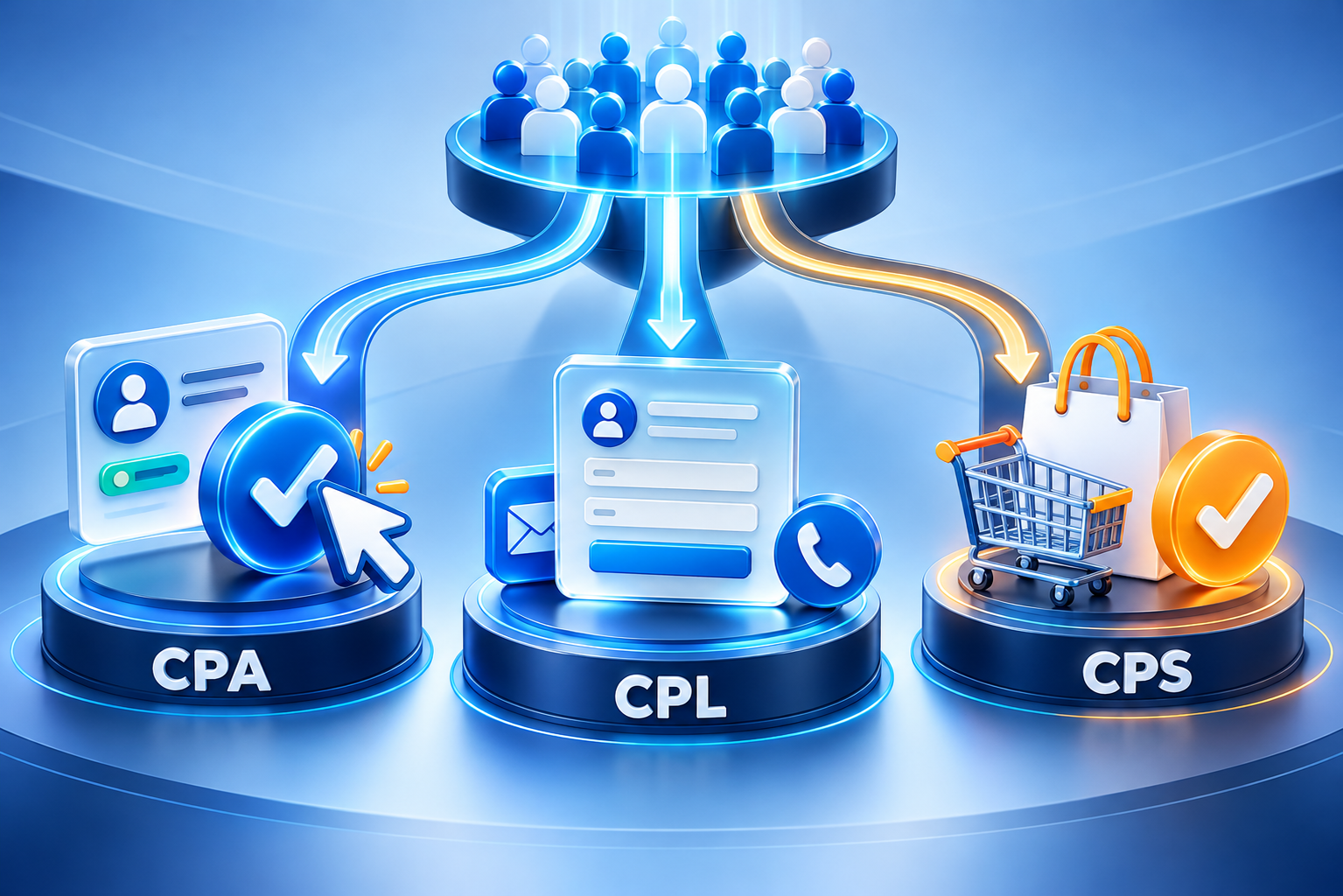
CPA, CPL, and CPS describe different ways advertisers compensate publishers for results. The labels provide a starting point, but they do not replace the campaign’s conversion definition.
| Model | Meaning | Typical payable result |
|---|---|---|
| CPA | Cost per action or acquisition | A specified qualifying action, such as a verified registration or an activated account. |
| CPL | Cost per lead | A lead that satisfies the advertiser’s eligibility, information, and quality requirements. |
| CPS | Cost per sale | An eligible purchase, usually subject to validation and applicable cancellation or return rules. |
CPA is sometimes used as an umbrella term that includes lead and sale campaigns. A network might therefore label an offer “CPA” even when its payable event is an approved lead or a purchase.
Always ask: What exact event triggers the commission, and what conditions must that event meet?
How Does CPA Work?
A CPA campaign pays a publisher when a referred user completes a defined action that meets the offer’s requirements.
The action might involve:
- Registering an account and completing identity verification.
- Starting an eligible subscription.
- Installing an application and completing a required in-app event.
- Opening an account and completing a qualifying first transaction.
Some campaigns require several steps. A registration may appear in reporting without generating a commission if the user still needs to complete verification, activation, or another qualifying event.
When CPA may fit your traffic
CPA may suit an audience that understands the product and is willing to complete the full conversion process. Tutorials, product walkthroughs, and detailed comparison content can help explain what users need to do before they click.
Before choosing an offer, assess whether your traffic can complete the required journey. A high payout for a demanding action may produce less revenue than a lower payout for an action that better matches your audience.
How Does CPL Work?
A CPL campaign pays for a qualifying lead. This often involves a user requesting information, submitting an inquiry, or expressing interest in a product or service.
Examples include:
- Requesting an insurance quote.
- Submitting an eligible service inquiry.
- Completing a consultation request.
- Submitting an application that meets the campaign’s lead requirements.
A submitted form does not automatically qualify for payment. An advertiser may check contact validity, location, duplicate status, consent records, or other agreed criteria.
When CPL may fit your traffic
CPL may suit visitors who are actively exploring options but are not ready to purchase. Educational articles, comparison pages, and service guides can connect this research intent with a relevant next step.
Lead quality matters alongside volume. Visitors should understand what they are requesting and what may happen after submitting their information.
How Does CPS Work?
A CPS campaign pays when a referred user makes an eligible purchase. The commission may be a fixed amount per sale or a percentage of the eligible transaction value.
For percentage-based commissions, campaign rules may exclude shipping, taxes, discounts, or particular products from the commission calculation.
A recorded sale may remain pending during a validation period. Returns, cancellations, attribution issues, or other campaign conditions can affect the final commission.
When CPS may fit your traffic
CPS may suit visitors who are close to making a purchase. Product reviews, buying guides, demonstrations, and comparisons between specific alternatives can help users make a decision.
Check product availability, purchase restrictions, and the destination page experience. Strong buying intent has limited value if the product is unavailable or the checkout process creates unnecessary friction.
Match the Model to Your Audience’s Intent
Audience intent describes what a visitor is trying to accomplish. Someone learning about a category has different needs from someone comparing providers or preparing to buy.
| Audience intent | Potential model fit | What to check |
|---|---|---|
| Learning about a problem or product category | CPL or a suitable CPA event | Whether the next step is useful and appropriate at this early stage. |
| Comparing providers or requesting personalized information | CPL | Lead eligibility, information requirements, and the follow-up experience. |
| Ready to register, verify, or activate a service | CPA | The complete action required, including any additional qualifying events. |
| Ready to purchase a specific product | CPS | Purchase eligibility, commission calculation, and return or cancellation rules. |
These are starting points rather than fixed rules. An educational article can generate sales, and a visitor with strong purchase intent may still prefer to request a quote first.
The best fit is the offer whose conversion process naturally follows from the visitor’s goal.
Which Model Fits Your Traffic Source?
A traffic source does not determine the payout model by itself. The message, audience, placement, and destination experience all influence the result.
SEO and content websites
Match offers to the purpose of each page. An informational guide may support a relevant lead request, while a detailed product comparison may support a sale or an account activation.
Social media and short videos
Social content can generate interest before users have a clear intention to convert. Explain the offer and its requirements accurately, then use an appropriate landing page when permitted. CPA, CPL, and CPS can all work when the audience and message fit.
An engaged subscriber audience may respond to lead offers, account-based campaigns, or product recommendations. Relevance, subscriber expectations, and campaign permission are essential.
Paid search
Search queries can reveal specific intent. Quote-related searches may suit CPL, product purchase searches may suit CPS, and service registration searches may suit CPA. Confirm campaign restrictions, including any rules on brand bidding, before launch.
Paid social and display
These placements may require more explanation before a user is ready to act. Evaluate approved conversions and acquisition costs carefully rather than relying on clicks or early tracked events.
Coupon, cashback, and incentive traffic
Use these methods only when the campaign explicitly permits them. A payout model does not automatically authorize incentives or particular promotional placements.
Compare Approved Earnings Instead of Payout Alone
A larger commission per conversion does not necessarily generate more revenue from the same amount of traffic.
For a fixed-payout campaign:
Approved commission revenue = Approved conversions × Payout per approved conversion
The following hypothetical example compares three campaigns, each receiving 1,000 clicks.
| Metric | CPL example | CPA example | CPS example |
|---|---|---|---|
| Clicks | 1,000 | 1,000 | 1,000 |
| Tracked conversions | 100 | 30 | 15 |
| Approved conversions | 70 | 24 | 12 |
| Payout per approved conversion | $8 | $25 | $40 |
| Approved commission revenue | $560 | $600 | $480 |
| Approved earnings per click | $0.56 | $0.60 | $0.48 |
These figures are illustrative, not performance benchmarks. All tracked conversions in the example have completed review, and the CPS example uses a fixed commission per sale.
The CPS campaign has the highest individual payout, but the CPA campaign generates the highest approved revenue in this scenario.
Approved earnings per click = Approved commission revenue ÷ Clicks
If each campaign incurred $400 in advertising spend, the amount remaining after that spend would be $160 for CPL, $200 for CPA, and $80 for CPS. These amounts exclude other expenses, taxes, and later adjustments.
Use comparable traffic, reporting periods, and validation stages when evaluating offers. Different audiences or unresolved pending conversions can make comparisons misleading.
Consider Validation and Cash Flow
Campaign performance includes when earnings become payable and when payment is received.
A CPL offer may require lead quality checks. A CPA offer may depend on confirmation of several events. A CPS offer may remain pending through a return or cancellation period.
None of these models automatically guarantees faster approval or payment.
Before committing a budget, confirm:
- Validation timeline: How long does conversion review normally take?
- Rejection rules: Which conditions make a conversion ineligible?
- Adjustments: Can approved commissions be reversed under the agreed terms?
- Payment schedule: When does the payment period begin?
- Payment conditions: Do thresholds, account checks, or advertiser funding conditions apply?
- Dispute process: How can publishers request clarification about rejected results?
Advertising costs may fall due before commissions are received. Choose a testing budget that accounts for this gap.
How to Test the Right Model for Your Traffic
1. Define your audience and its next step
Identify who your visitors are, what they need, and whether they are likely to request information, complete an account process, or make a purchase.
2. Select offers with compatible requirements
Check GEO, eligibility, traffic permissions, conversion conditions, caps, and promotional restrictions. Compare offers that serve a similar audience need where possible.
3. Test tracking before launch
Follow the campaign’s approved testing process. Confirm that your links and permitted tracking parameters support the reporting you need.
4. Start with a manageable test
Use a limited amount of traffic or advertising spend. Record performance by offer, source, placement, or creative where reporting allows.
5. Evaluate reviewed results
Compare approved earnings per click, approval rates, and cost per approved conversion. Allow for validation delays before judging recent activity.
6. Increase traffic based on evidence
Scale gradually when reviewed results support the economics and the campaign can accept additional volume. Continue monitoring quality and later adjustments.
Common Mistakes When Choosing a Payout Model
Assuming CPL always converts more easily
A lead campaign may have demanding qualification requirements. A shorter form does not guarantee a payable lead.
Choosing the highest payout
Evaluate how often your audience completes an approved conversion and what it costs to acquire that result.
Sending every visitor to the same offer
Different pages and placements may attract different levels of intent. Match the offer to the context.
Counting pending conversions as confirmed earnings
Separate tracked, pending, approved, and paid results when reviewing reports and planning cash flow.
Assuming a model permits your traffic method
Traffic permissions belong to the individual campaign. Confirm them regardless of whether the offer uses CPA, CPL, or CPS.
Frequently Asked Questions
Which model is best for beginners?
- There is no universal best model. Start with an offer you can explain accurately, an audience that fits its requirements, and a permitted traffic source you understand.
Is CPL a type of CPA?
- It can be described that way when CPA is used broadly to mean payment for a qualifying action. CPL identifies the specific action as a lead. Use the campaign’s payable-event definition to avoid ambiguity.
Does CPS always pay a percentage of the sale?
- No. CPS campaigns may pay a fixed amount per eligible sale or a percentage of eligible transaction value. The commission calculation depends on the offer.
Can one website use all three models?
- Yes, if the relevant campaigns permit the website’s traffic and promotional methods. Different articles or placements can support different offers based on visitor intent.
Should I switch models if conversions are low?
- First check audience fit, tracking, messaging, eligibility, and the destination experience. Low conversion volume can reflect these factors rather than the payout model itself.
Which metric should I use to compare offers?
- Approved earnings per click is useful for comparing revenue generated from traffic. Review it alongside acquisition costs, approval rates, validation timelines, and later adjustments.
Find the Right Fit With MaxPoint Media
The right payout model connects your audience’s intent with a realistic, qualifying next step.
CPL can support relevant inquiries, CPA can reward defined account or service actions, and CPS can suit visitors ready to purchase. Your results depend on the complete offer and user journey.
At MaxPoint Media, we encourage publishers to evaluate audience fit, campaign requirements, and approved performance together before scaling.
Ready to explore offers for your traffic? Connect with MaxPoint Media to discuss your audience, promotional methods, and target markets.